
Introduction:
The name history of Cacatua leadbeateri reflects a fascinating mix of British taxidermy, colonial exploration, and indigenous recognition.
Indigenous Names:
Long before Europeans arrived, there were many local indigenous names.
In southeast Australia (now New South Wales) the Wiradjuri people called the bird 'wijugla', which was later
Anglicized to 'wee juggler'.
In Central Australia the Pitjantjatjara term is 'kakalyalya'.
Names recorded from South Australia include 'kukkalulla' (Kokatha dialect of Western Desert language),
'nkuna' and 'ungkuna' (Arrernte), 'yangkunnu' (Barngarla), and 'yangwina' (Wirangu), and 'yel-le-lek' (from the Wimmera), and 'cal-drin-ga' (from the lower Murray).
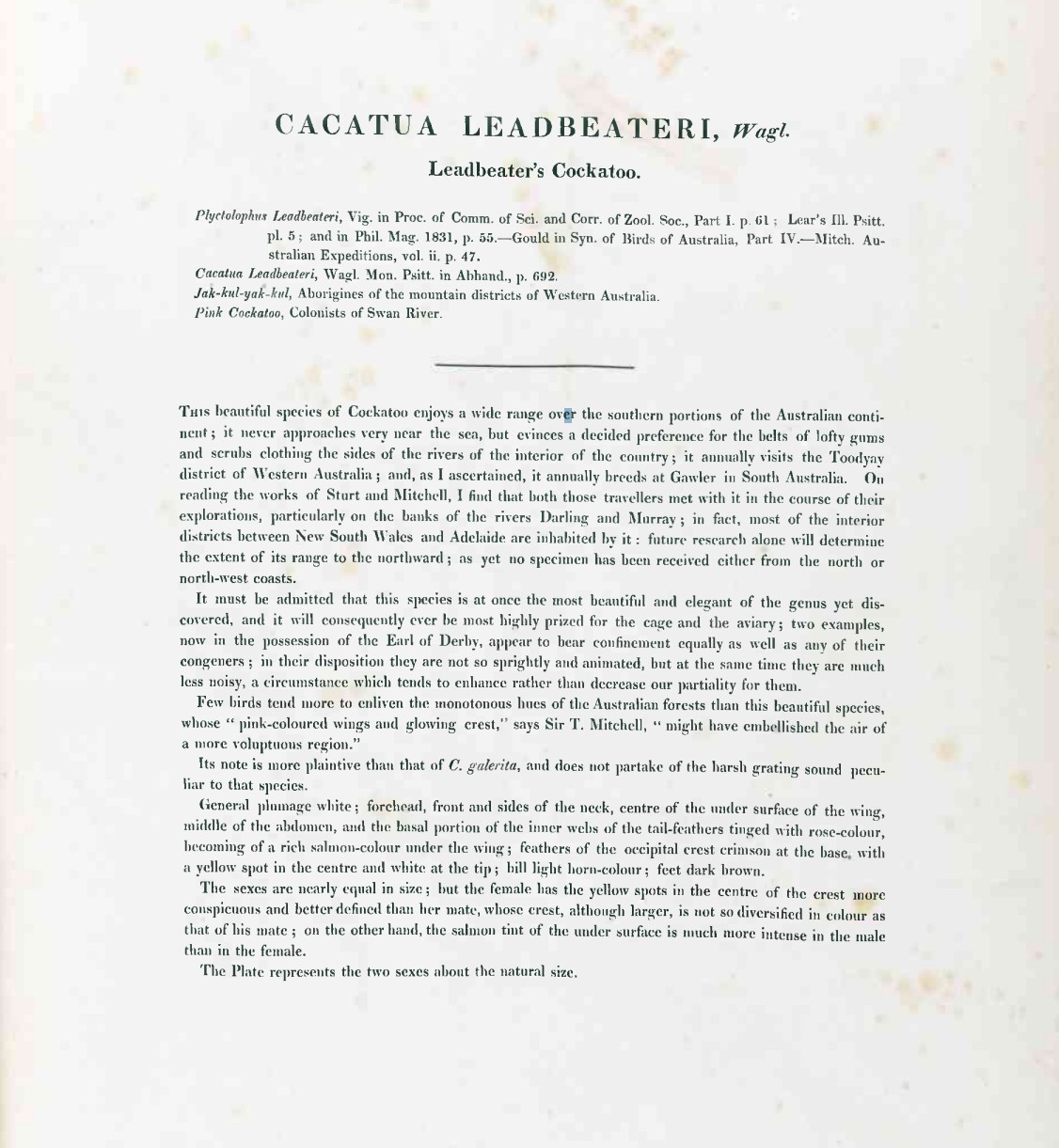
In Western Australia, the indigenous name 'Jak-kul-yak-kul' is noted.
Ornithological Names:
1831 - British naturalist Nicholas Aylward Vigors formally described the species, assigning the scientific name Plyctolophus leadbeateri. The species name leadbeateri honors Benjamin Leadbeater, a prominent London naturalist, ornithologist, and taxidermist who provided Vigors with the type specimen.
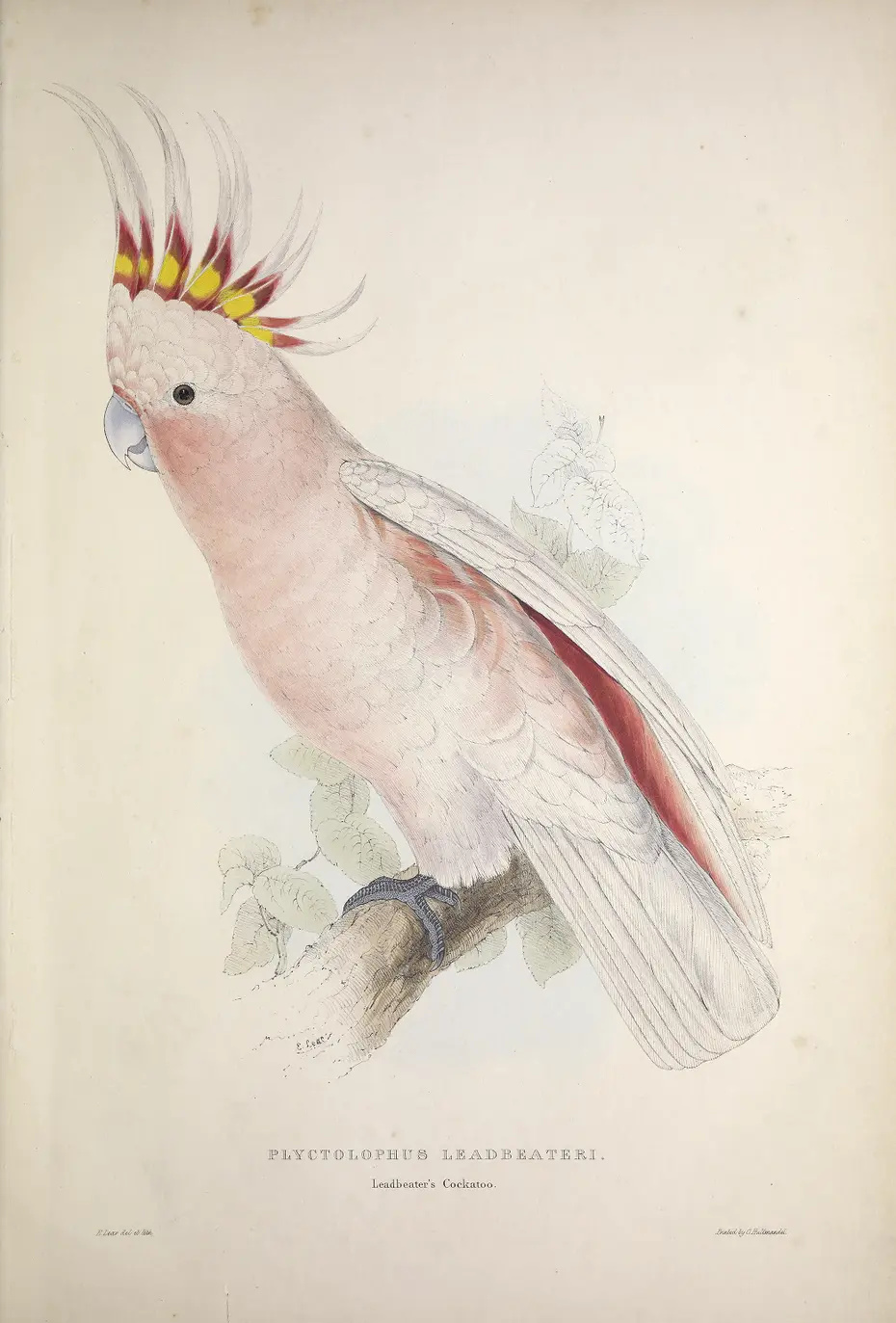
1832 - English artist and poet Edward Lear illustrates the bird, calling it Leadbeater's Cockatoo.
1836 - Thomas Mitchell, an explorer and the Surveyor General of New South Wales undertakes his third
expedition with the aim of
exploring and surveying the lower part of the Darling River. During this
expedition he encounters this bird, calling it the Red-top Cockatoo.
He writes in his diary "Few birds more enliven the monotonous hues of the Australian forest than this beautiful species whose pink-coloured wings and flowing crest might
have embellished the air of a more voluptuous region".
During this same expedition, he directs a massacre of Kureinji and Barkindji Aboriginal people on the Murray River at a site now called Mount Dispersion.
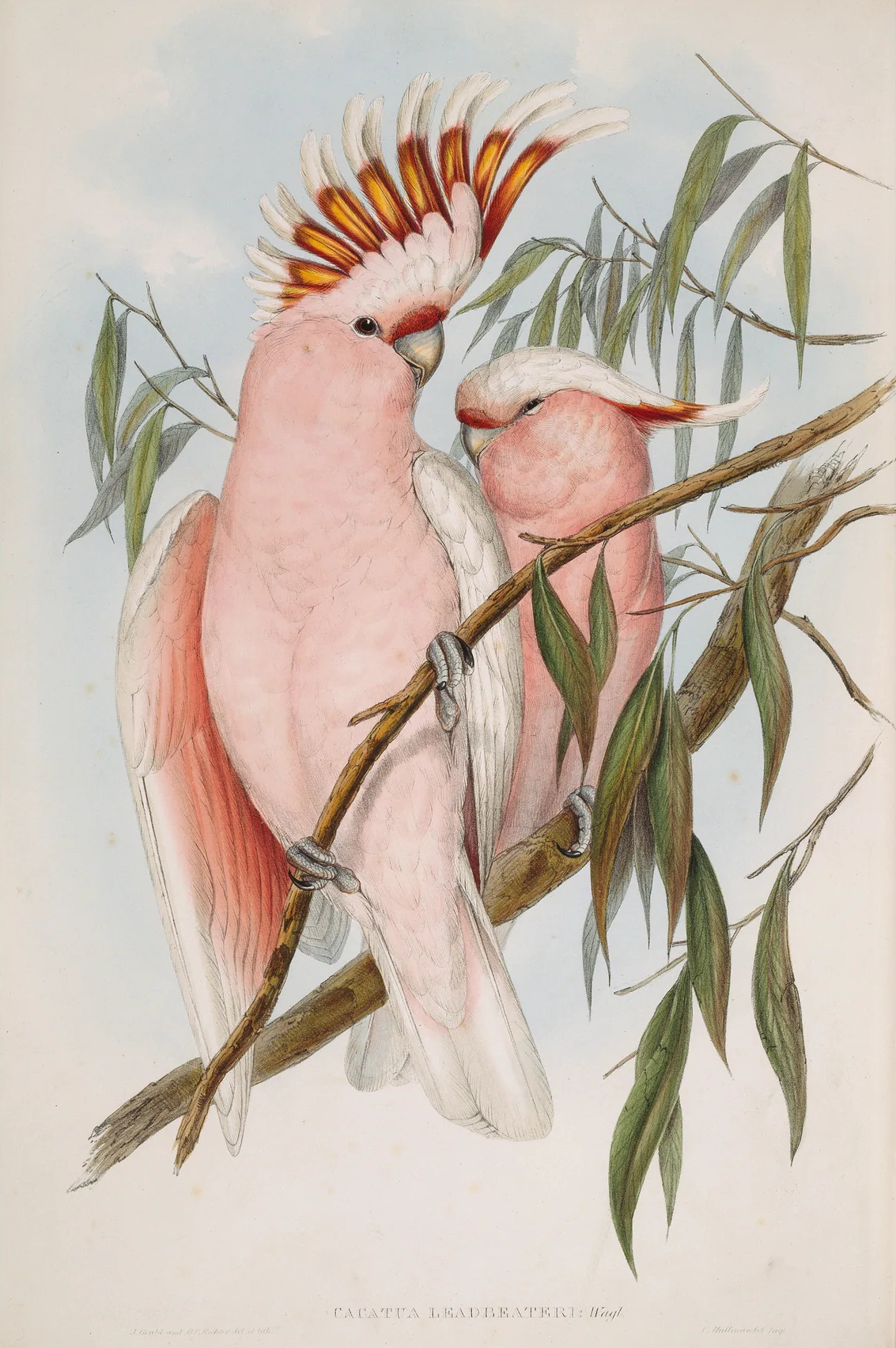
1838-1840 - Prominent British ornithologist John Gould and his wife Elizabeth visit Australia to conduct field research for the 7 volume work 'The Birds of Australia' which is published in parts from 1840 to 1848. Volume 5 describes this cockatoo as Leadbeater's Cockatoo with the genus Cacatua and includes a hand-coloured lithograph by Henry Constantine Richter which was derived from sketches and drawings by Elizabeth Gould. It is also noted by Gould that the colonists of Swan River call the bird the Pink Cockatoo.
1857 - The species is placed into the monotypic genus Lophochroa by the ornithologist Charles Bonaparte.
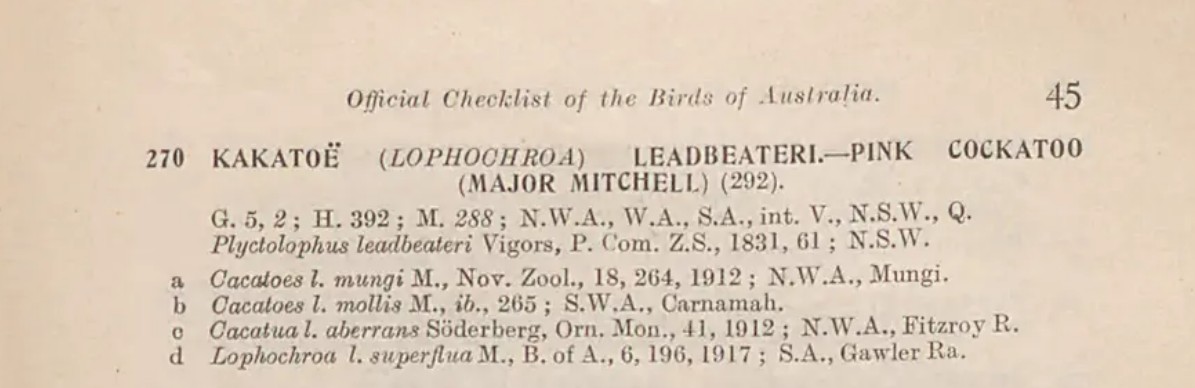
1926 - Official documentation of the Royal Australasian Ornithologists Union (RAOU) list the bird as the Pink Cockatoo, with Major Mitchell as an alternative.
1977 - Members of the Royal Australasian Ornithologists Union (RAOU) vote to rename the bird to the Major Mitchell's Cockatoo, inspired by Thomas Mitchell's glowing reports of the cockatoo in his publications.
1997 - The Royal Australasian Ornithologists Union (RAOU) officially becomes Birds Australia.
2012 - Birds Australia merges with Bird Observation and Conservation Australia to become BirdLife Australia.
2023 - Birdlife Australia and the International Ornithologists' Union (IOC) officially renames the bird back to Pink Cockatoo to replace the colonial-era name and prioritize more culturally inclusive terminology. The Genus is also changed from Lophochroa to Cacatua.
Bibliography & Links:
The many names of the Pink Cockatoo by Aidan Elwig Pollock
What's in a name? The renaming of the pink cockatoo is no small thing in Australia's violent history by Andrew Stafford

